
INSIGHT Inventory Series
The INSIGHT Inventory Series is a strengths-based personality and behavioral style assessment that helps people gain in-depth insights into themselves, better understand others, and identify how to flex (adapt) their style to communicate better. The INSIGHT Inventory is one of the best personality and behavioral style assessments for coaching and talent development. Developed to be easy to complete, simple to understand, and practical to apply, it uses every-day, conversational language (no codes, colors, labels, or quotients) which makes it possible for users to immediately discuss the results with each other and even with those who haven’t yet taken it.
About this Test
A positive, strengths-based personality assessment
INSIGHT Inventory®…understanding yourself and others
The INSIGHT Inventory is one of the best personality and behavioral style assessments for coaching and talent development. The INSIGHT Inventory is not a DiSC version, a MBTI derivative, StrenghtsFinder2.0 indicator or the Insights Discovery test. However, we believe all assessments have specific value and we provide resources to use the INSIGHT Inventory with other assessments in complementary ways (1+1>2). The INSIGHT Inventory is most closely related to factor-analytically derived assessments such as the 16 PF, Big 5, or Hogan Assessment. However, the INSIGHT Inventory it is uniquely different since it focuses on Kurt Lewin’s Field Theory, how people change from one setting to another rather than on only identifying traits.
Easy-to-use
The INSIGHT Inventory was specifically developed to be easy to complete, simple to understand, and practical to apply. It uses every-day, conversational language (no codes, colors, labels, or quotients) which makes it possible for users to immediately discuss the results with each other and even with those who haven’t yet taken it.
Unique
The INSIGHT Inventory is different than other assessments on the market. Instead of labeling people and trying to predict behavior, it emphasizes that behavior may change from one situation to another. Participants describe their behavior in two different environments, work and personal, and receive two profiles. It’s important to consider different profiles because they provide “insight” into the whole person across various situations, not just a single glimpse of a person’s static personality profile or type.
Empowering
The interpretive booklet included with the INSIGHT Inventory Series helps users develop skills and strategies for communicating better. Special sections about flexing one’s style answer the “So what?” question with practical guidelines that can be implemented immediately to improve personal effectiveness and build stronger, more effective relationships.
Versions
Available in three versions: Paper booklet or two online report styles, interpretive or personalized.
INSIGHT Inventory® booklet
Paper Booklet
1) self-scoring assessment and profile chart
2) interpretative guide (11 pages)
3) Five supporting discussion activities
The INSIGHT Inventory® is a classroom style workbook format that is ideal for training sessions or one-to-one coaching.
INSIGHT Inventory® Interpretive report
Online
1) self-scoring assessment and profile chart
2) interpretative guide (11 pages)
3) Five supporting discussion activities
The INSIGHT Inventory® Interpretive report is a classroom style workbook format that is ideal for training sessions or one-to-one coaching. This report is the online version of the paper booklet
INSIGHT Inventory® Personalized report
21-pages
Online digitally scored assessment
Personality profile and personalized report
View and print reports on demand
The INSIGHT Inventory® Personalized report is a narrated style written to the participant they can read and understand without a facilitator.
INSIGHT Inventory Team Map
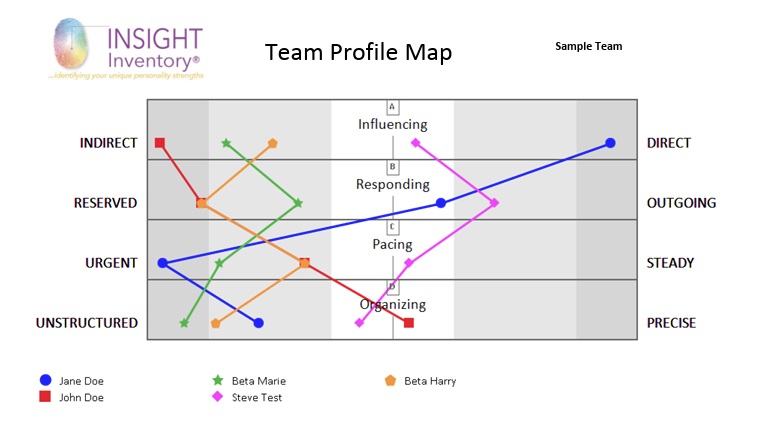
The INSIGHT Inventory Team Map provides a visual overview of a team’s profile results. This allows team members to see the traits they have in common or where they are different.
Conversational Language
The INSIGHT Inventory was designed to avoid labels and codes that had to be memorized or interpreted and instead uses every day terminology. This gives people positive, user-friendly terms to use when discussing their strengths with others. This is called “conversational language” because the results can be used immediately when discussing what was learned with others without the need for explanation.
No type codes, colors, EQ ratings, or catch phrases are used thus solving the problems some individuals have with these terms. With many other assessments that use colors and codes:
- Individuals can get “hung up” on the terms and view them as labeling.
- Some categories used to describe personality differences can be awkward.
- Individuals can’t remember their codes and apply skills they learned.
- Some individuals resist sharing their results because they feel stereotyped by the labels and restricted by their definitions.
Because the INSIGHT Inventory uses every day terminology, individuals that haven’t taken it yet can still participate and feel included in conversations. Everyone immediately understands these terms; no one is left out, no one feels uncomfortable for forgetting a code, and no one has to ask what the terminology means.
The objective is to empower and include users without subjecting them to a complicated code-embedded language. Instead, they can move quickly to learning and practicing useful skills. It makes it simple for people to understand who they are and how they interact with others. The Interpretive Guide gives them skills and strategies for development they can implement immediately. This framework is why the INSIGHT Inventory is used as the foundation tool for many programs including:
Communication & Interpersonal Skills
- Leadership & Management
- Teambuilding & Conflict Resolution
- Career Planning & Job Interviewing
- Customer Service
Bridge with other assessments
The INSIGHT Inventory complements and expands awareness when “bridged” with other assessments. It seamlessly integrates with the MBTI, DiSC, Big 5, StrengthsFinder 2.0 and many other assessments and programs.
INSIGHT Inventory Series Versions Available
The INSIGHT Inventory SELF
identifies traits that are unique to each individual. It focuses on the positive characteristics and explores how to expand and maximize people’s strengths and is a strengths-based, positive, and easy to understand personality assessment. The paper-based and online (Interpretive) SELF reports are a classroom style workbook format that is ideal for training sessions or one-to-one coaching. The online SELF Narrative report is a narrated style written to the participant they can read and understand without a facilitator.
- gain in-depth knowledge about their personality styles
- understand and appreciate other people’s styles
- clarify what situations are stressful and develop strategies for managing stress
- learn to flex (adapt) their style to communicate better
- improve their personal effectiveness
- build stronger, more effective relationships
INSIGHT Inventory TEAM MAP
Is a self-assessment with an expanded interpretive guide for team communication and development. It identifies traits that are unique to each individual and explores how the different personalities impact the team dynamics and is a strengths-based, positive, and easy to understand personality assessment. It has an expanded interpretive guide with an emphasis on team communication. The TEAM personality profile assessment helps team members discover a more accurate perception of themselves and each other. It reveals each team member’s personality traits and teaches them how to utilize their strengths to communicate more effectively, strengthen relationships, improve team engagement and perform at a higher level. It is a classroom style booklet format that requires a facilitator or coach for interpretation. Participants will:
- gain in-depth knowledge about their personality styles
- understand and appreciate their team member’s styles
- clarify what situations are stressful and develop strategies for managing stress
- learn to flex (adapt) their style to communicate better
- learn to work better with their team leaders and managers
- understand how personality traits interrelate with the team stages
- build stronger, more effective teams
INSIGHT Inventory TEAM MAP will help to:
- Increase awareness and productivity
- Improve team communication
- Resolve conflict and build stronger relationships
Field Theory
Field Theory, developed by Dr. Kurt Lewin (1890-1947) emphasized that a person’s behavior (B) can best be understood by studying the interaction between his/her personality (P) and environmental pressures (E): B = Æ’(P, E). This theory was used because the INSIGHT Inventory asks participants to describe how they are in two environments, at work and at home. The two profiles help people determine how the different environments affect their behavior and better understand why they behave the way they do.
Trait Theory
The use of adjectives as test items for the measure of personality traits was first formally studied and given scientific credence by Dr. Gordon Allport (1897-1967). Allport and Odbert (1936) identified over 4500 words in the English language which they felt described personality characteristics. These were divided into what was believed to represent various types of traits, dispositions, habits, attitudes, intentions, and motives. As a trait theorist, Allport wrote extensively about insight which he felt represented the mature personality, one characterized by self-awareness, acceptance, and good humor. The INSIGHT Inventory credits its name to Allport’s emphasis on “insight”, which he called the most desirable of all traits.
Factor Analysis
Dr. Raymond Cattell (1905-present) pioneered the technique of using factor analysis to identify the most powerful factors of a personality test. Cattell developed the well respected Sixteen Personality Preferences assessment, commonly called the 16PF, through factor analysis. Although it has 16 scales and the INSIGHT Inventory measures four traits, they have close correlations probably due to their similar technical development. Items (adjectives) on the INSIGHT Inventory were selected based on statistical analysis of their factor loadings. This resulted in the creation of personality scales that give people a meaningful and scientific way to compare themselves with others.
What is the INSIGHT Inventory Series?
It’s a strengths-based personality and behavioral style assessment that helps people gain in-depth insights into themselves, better understand others, and identify how to flex their style to communicate better.
The INSIGHT Inventory is aligned with Kurt Lewin’s Field-Theory and seeks to understand behavior by identifying the impact of different environments on personality tendencies. This gives users practical ways to describe how they behave when alone and in groups. In addition, it provides an easy-to-understand model for examining the internal force field, external pressures, and their combined impact on their behavior.
Regarding the research model, the INSIGHT Inventory is more closely related to the 16-PF (Sixteen Personality Preferences) developed by Cattell and the Big 5. The scales on all three of these were developed using statistically based factor analysis.
INSIGHT’s underlying philosophy (shared somewhat with the Hogan HPI) is tied to the field of social anthropology which examines how humans actually developed the innate personality traits that allow us to survive and thrive within pairs and groups.
FAQs
Is the INSIGHT Inventory Series new on the market?
No. The INSIGHT Inventory is well established, now in 30th year, and well researched. In fact, it is one of only a few non-clinical assessments reviewed positively by Buro’s Mental Measurements Yearbook (an independent test review agency with extremely high academic standards).
Is the INSIGHT Inventory the same as the Insights Discovery assessment?
No. That is a different product and company headquartered in the UK but used widely in the US, It uses a different color-based quadrant /circumflex model.
Is the INSIGHT Inventory a DiSC instrument?
No. Since much of the copyright on the original writings of Marston and Cleaver has expired, many assessments using the DiSC model have proliferated, but the INSIGHT Inventory, however, is not related.
Is the INSIGHT Inventory a MBTI (Myers-Briggs Type Indicator) derivative?
No. The MBTI was developed by Isabel Briggs Myers and she credits the influence of Carl Jung’s writings on personality. There are several other Jungian derived assessments. The INSIGHT Inventory is not related yet it actually complements the MBTI and the two can be used effectively together.
Is the INSIGHT Inventory similar to Gallup’s StrengthsFinder 2.0 or TMBC’s StandOut?
No. These assessments identify general personality themes that drive people. Both of these assessments complement the INSIGHT Inventory nicely. It’s sometimes said that INSIGHT describes how a person walks and talks coming down the hall and StrengthsFinder or StandOut describe why the person is coming down the hall. People instinctively respond first to observable behavior (INSIGHT), then once a connection is made they deal with the reason driving the behavior (StrengthsFinder and Standout).
Additional information
| Appropriate For | |
|---|---|
| Administration Time | |
| Format | |
| Scoring Options | |
| Language | |
| Legal in Canada? |
Search for Other Tests:
Not sure if this test fits your needs?
We can help you to make the right choice.