
3-D Reasoning Aptitude Test
The 3-D Reasoning Aptitude Test is a rapid, 5-minute timed online assessment designed to evaluate a candidate’s three-dimensional spatial thinking and visualization capabilities. Comprising 45 items, this highly efficient test measures an individual’s ability to mentally manipulate solid objects and conceptualize how internal mechanical parts fit together when they cannot be actively seen from the surface.
About this Test
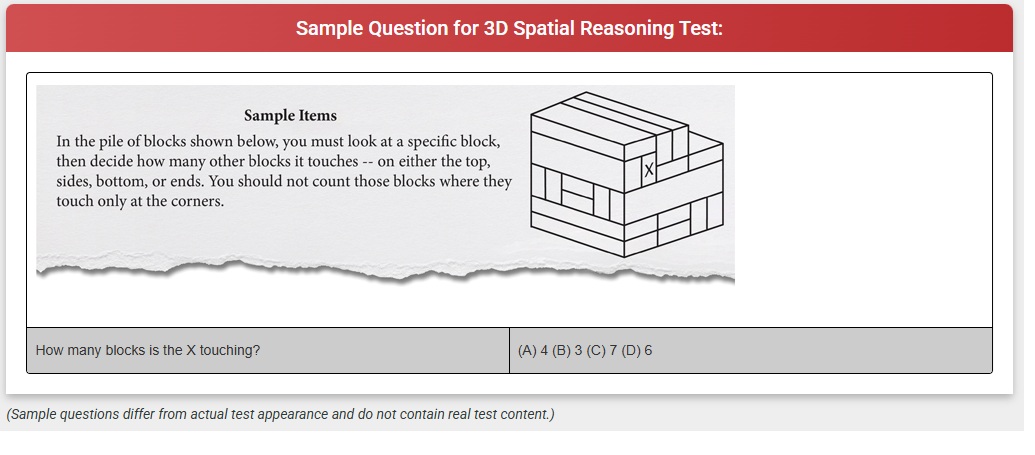
The 3-D Reasoning Aptitude Test evaluates a person’s ability to think in terms of three dimensions and to see how solid objects fit together.
Structure: This 5-minute test has 45 questions.
Often used with: 2-D Spatial Recognition Test
When To Use this Test
The 3-D Spatial Reasoning Test is appropriate for any job where the employee must be able to conceptualize how parts fit together in ways that are unable to be visualized from the surface.
It should be used to assess fit for jobs where the individual is responsible for taking things apart and putting things together (e.g., machine setup, mechanical troubleshooting), as well as for design work with solid objects that must fit together (e.g., architectural drawings, equipment design).
For Positions Such As
- Maintenance technician
- Mechanic
- Machine designer
- Architect
- Draftsman
- CAD technician
What It’s Best Used For
This screening tool is best utilized during the early pre-employment phase or internal promotion cycles to verify solid spatial awareness and technical troubleshooting logic before hiring.
- Targeting Technical Roles: Highly recommended for screening mechanics, maintenance technicians, machine designers, architects, draftsmen, and CAD technicians.
- Predicting Work Quality & Output: Identifies high-performing individuals who are statistically proven to finish assembly, design, and repair tasks much faster and with higher overall quality.
- Preventing Production Delays: Flags low-scoring applicants who may struggle to solve mechanical issues independently, preventing long completion times and a heavy reliance on other workers for help.
- Gauging Learning and Judgment: Validated research proves scores strongly correlate with a candidate’s overall job performance, learning agility, team coordination, and practical field judgment.
The unproctored platform supports both English and Spanish language settings, generates an immediate online report, and is fully legal for use in Canada. (Note: It is frequently deployed alongside the 2-D Spatial Recognition Test to get a full geometric aptitude profile).
High Scorers
People scoring high on the 3-D Spatial Reasoning Test are better able to see how parts fit together, so they are quicker and more capable in accomplishing tasks.
Low Scorers
People scoring low on the 3-0 Spatial Reasoning Test may not be able to perform the same tasks as high scorers. They may not be able to figure out the relationships of how objects fit together, so their efforts to do troubleshooting or design work may be exceedingly long-they often need assistance from other workers to complete their assignment.
Validity Information
On average, this test was found to be significantly related r=.22* with productivity; r=.34** with quality; r=.28* with overall job performance rating; r=.24* relations with supervisor; r=.22* with stress tolerance; r=.23* with attendance; r=.30** with ability to learn; r=.24** with teamwork; r=.20* with judgement; r=.21** with planning ability; r=.37** ability to learn; r=.24* with skills competence; r=.39** openness to new learning; r=.22* productivity; r=.21* dependability/reliability.
Additional information
| Appropriate For | |
|---|---|
| Administration Time | |
| Format | |
| Scoring Options | |
| Language | |
| Legal in Canada? |
Search for Other Tests:
Not sure if this test fits your needs?
We can help you to make the right choice.